Modular End-Effector for Beach Debris Cleanup · CDE3301 Design Report · AY 2026/27
BeachBoy
A quiet, modular attachment built to
collect debris from dry and wet sand.
Scroll through the machine and its test results
The problem
It must be cleared daily.
Most of the plastic litter on Singapore's beaches arrives from offshore. Tanjong, Siloso and Palawan beaches on Sentosa are cleaned by about 20 workers, split evenly between manual collection and machinery.
The wet band
Sieves blind on wet sand.
Tractor-towed sieves clear the dry sand. On the wet intertidal band, wet particles stick to the mesh wires and block the holes, so that strip is cleared by hand.
Workers sweep debris into piles and lift each pile into a tractor bucket, often in the heat. Above 32 °C WBGT, mandatory rest breaks take them off the sand.
- Most tiring task. Moving piles onto the bucket or utility vehicle is the most tiring part of the work.
- Noise. Tractors are too noisy to run when crowds are present.
- More tractors? They would face the same limits.
Technical review
Two gaps in existing machines.
Gap 1: maintainability
SUTD SAND-E. Its low-cost, exposure-resistant polycarbonate and aluminium guided our material choices. But its collection mechanism is built into the chassis, so it is hard to clean or maintain on the beach.
Gap 2: wet sand
The Searial Cleaners' BeBot. The only commercial beach-cleaning robot in Singapore. It sifts the top 10 cm of sand into a 100 L bin. It was trialled and rejected: it tipped when loaded, held too little and cost about twice a tractor's price. We also expect it to fail on wet sand, which clumps and blinds the mesh.
The carrier had to be repaired first
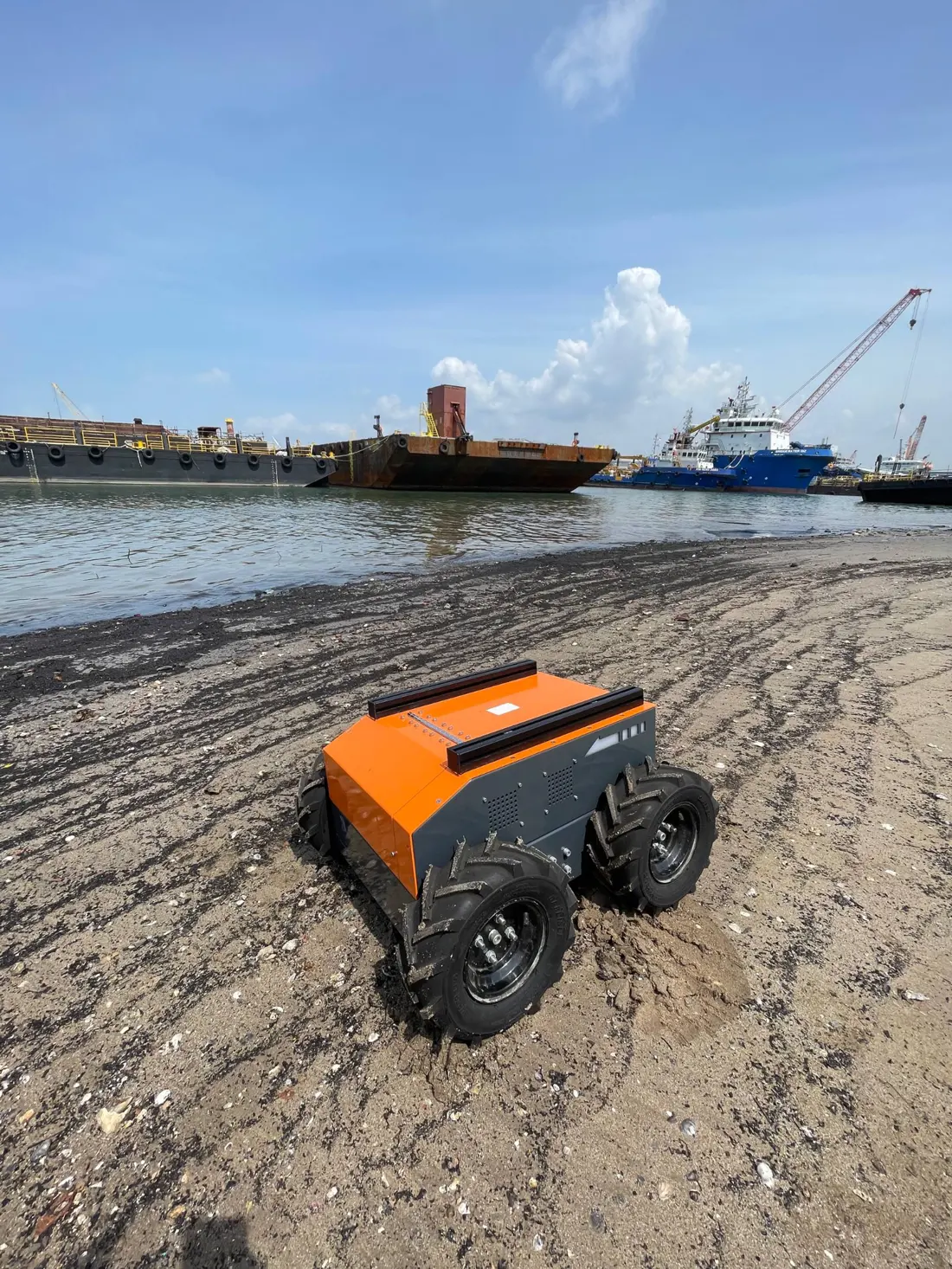
A Botsync Copernicus could not be driven at the start of the project. Its onboard computer would not power up, and the control board's STM32 microcontroller did not respond.
Over the summer, the team replaced the computer with a Raspberry Pi, modified the board to bypass the STM32, keeping only inrush current limiting and the E-stop, and set the Pi up to command the two motor drives directly over RS485.
To prove the repair, it was driven at West Coast Park on dry and wet sand. After 30 minutes of continuous operation with no faults, it was judged suitable as the base for the project.
Overall concept
Two stages on a Copernicus base.
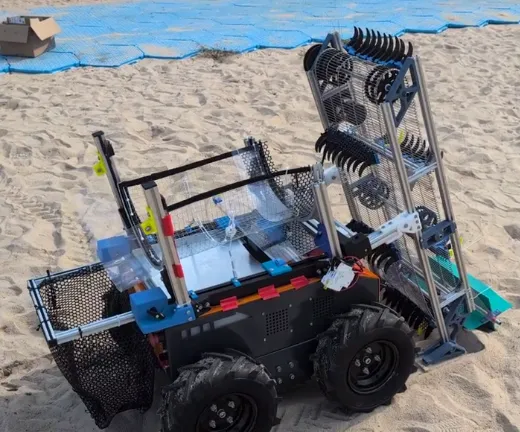
The conveyor lifts debris, shedding loose sand through its meshed belt. The half-drum then rocks the load against its mesh to remove remaining wet sand. Every subsystem comes off with quick-release pins.
- Conveyor debris collection
- Trommel half-drum debris separation
- Tray and bin debris storage
- Copernicus carrier, with 4040 payload rails
Drag to look around. The 3D model is an illustration, and Figure 3 of the report shows the final design.
Design report, Sections 2.1 and 2.2.1Stage 1 · Debris collection
Conveyor
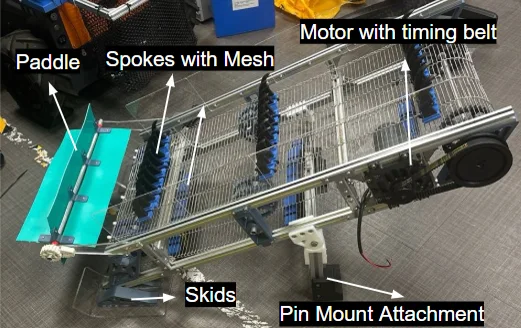
As the machine drives, hooked spokes on a mesh belt pick up debris with the sand around it and carry it up to the drum.
- Skids
- Ride ahead of the spokes and set the digging depth at 10 mm
- Spokes
- 35 cm belt with a 10 mm aperture, and a mesh strip across the spokes for small items
- Drive
- 24 V, 40 W geared motor, through an S5M timing belt at 3:1
- Paddle
- Ratchets to let debris in, and blocks items from pushing back out
- Mount
- Two 10 mm quick-release pins, lifts off without tools
Stage 2 · Debris separation
Trommel half-drum
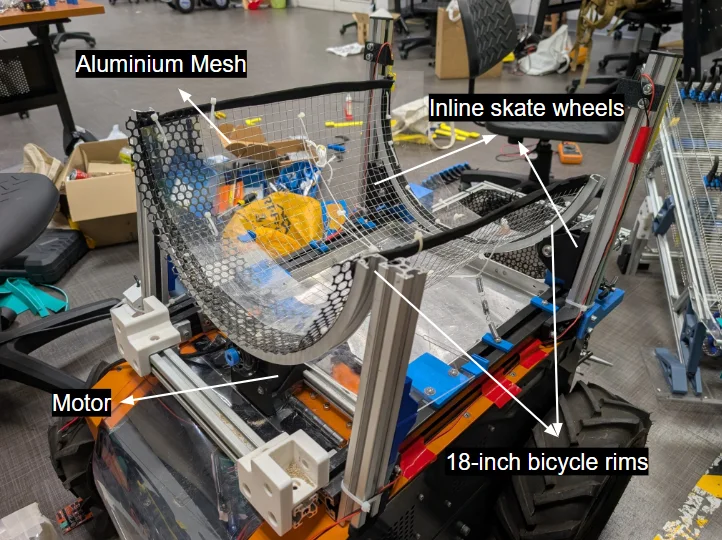
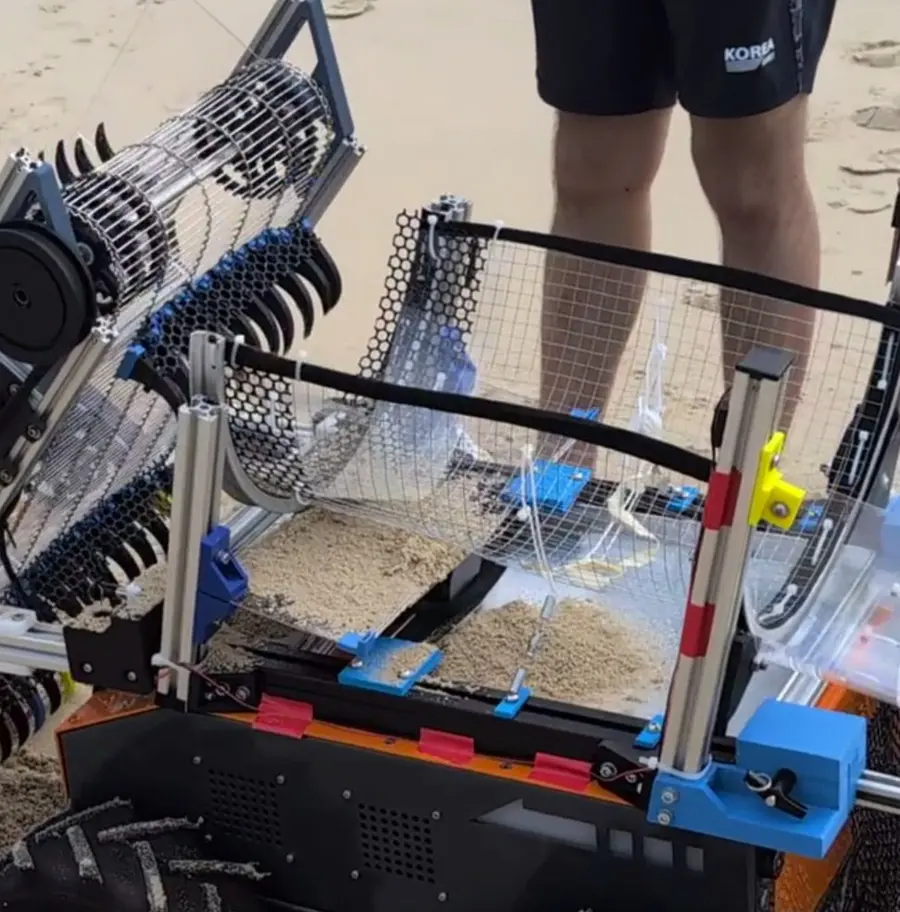
Flat vibrating screens blind on damp material, while trommels keep their holes clear by rotation. A rotating drum tested in Semester 1 separated wet sand well, but space constraints led to a U-shaped half-drum.
- Screen
- 5 mm mesh. Top half removed, so it takes the conveyor drop
- Wheels
- Inline skate wheels sized to the rim channel, so the rim holds its line
- Drive
- Friction drive at 0.24 of critical speed. The motor is calculated to supply 1.8 times the worst-case torque at an assumed 50% efficiency; grip at the contact was not measured
- Springs
- Two at the midpoint of the drum add downforce
Debris storage
Tray and bin
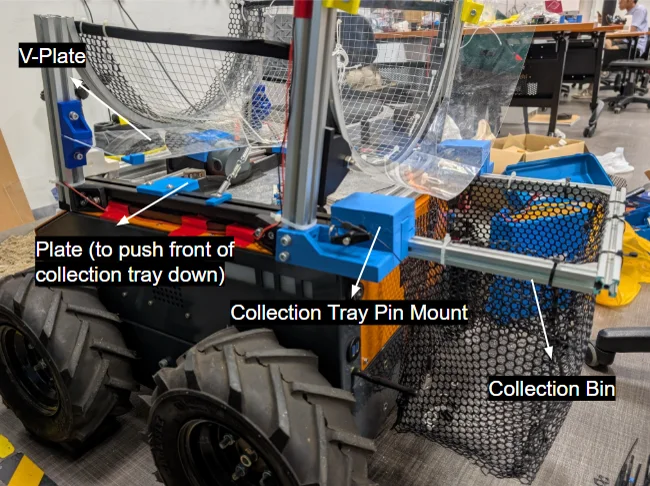
Separated sand collects on a tray, and debris in a meshed bin at the back of the robot. They are a connected unit that slides out through the back.
- V plate
- Acrylic, keeps sand off the motor
- Tray
- 1 mm aluminium, about 2.9 L at the brim
- Bin
- Meshed, at the back of the robot
- Pins
- Two 10 mm quick-release pins at the rear, with flat PETG pushers at the front
Electronics architecture
Two isolated power domains.
The carrier's LiFePO4 pack powers the wheel drives, and the module's 24 V sodium-ion pack powers everything else. They connect only through an isolated RS485 link, so a payload fault cannot reach the drives.
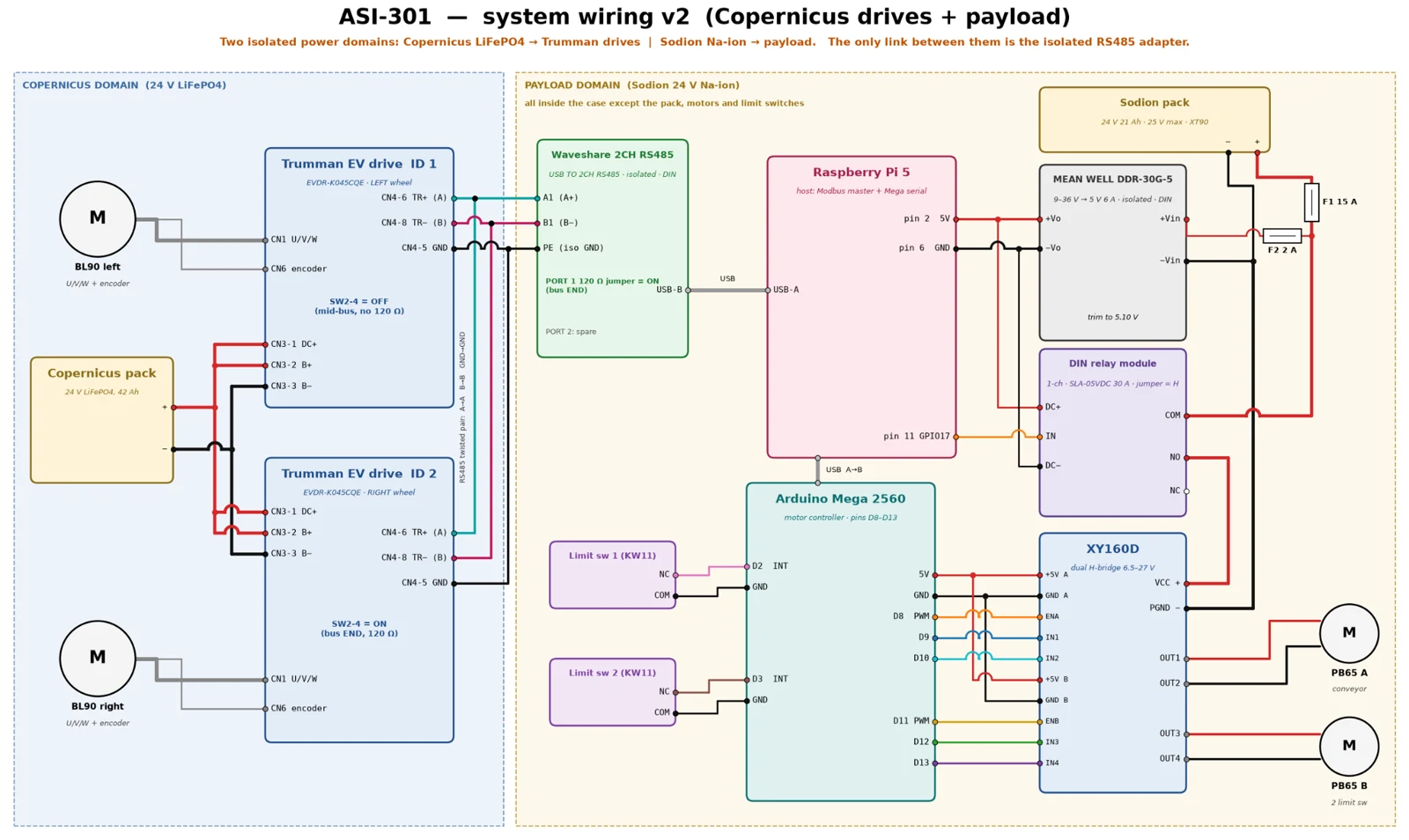
- Controllers
- A Raspberry Pi 5 talks to the servo drives over Modbus RTU and supervises an Arduino Mega 2560, which drives the motors
- Rocking
- Between two normally closed limit switches, coasting 150 ms at each end
- Broken wire
- A broken wire reads as a press, so the Mega stops the drum
- Case
- Removable acrylic, keeps out sand but is not sealed
Intended workflow
Alongside the tractors.
The system is meant to work alongside tractors, not replace them. Their sieves still handle the dry upper beach, while the system takes over the wet intertidal band.
- Collect. One worker drives it along the band by remote control, and a second walks alongside to clear jams.
- Empty the bin. A worker slides out the collection tray, empties the bin and tips the sand back onto the beach.
- Clean. At the end of a shift, workers pull the quick-release pins and clean each subsystem.
This animation shows the intended sequence, not a test result. The field results are below.
Design report, Section 2.3, Figure 14Development of the functional prototype
What each build changed.
| Build | Changed | Fixed | New problems |
|---|---|---|---|
| Conveyor | |||
| B1.0 | Free-pivoting 7 cm skids; motor drives the belt directly, 1:1; 35 cm mesh belt with printed spokes; conveyor angle set at 40° | Long items picked up | Skids pivot and block forward motion; spokes cannot reach digging depth; motor stalls; debris not handed into the drum |
| B2.0 | Bucket-scoop spokes tried, rejected; fixed brush at the handoff tried, rejected; skids locked | Skids no longer block | Scoops add digging load and stall the motor; brush leaves a gap |
| B3.0 | Skids cut from 7 to 5 cm; belt drive raised to 3:1; conveyor lengthened for a higher drop into the drum | No stalls through bench test 1; transfer reached 87.5% dry and 78.6% wet; long items pass intake | Small rigid items slip between spokes; large rigid items ride the spoke tips; flat items pushed ahead |
| Half-drum | |||
| B0.0 | 3D-printed 28 cm rim with a rubber strip; off-the-shelf castors; friction drive through the support wheels | Nothing yet | Drum drifts out of line; drum too small for the 35 cm belt |
| B1.0 | Bicycle rim; custom printed castors; frame and mounts rebuilt | Rim now wider than the belt | Castors loose in the rim channel |
| B2.0 | Inline skate wheels sized to the rim channel; fixed brush tried, rejected | Rim holds its line | Brush does not guide debris into the drum |
| B3.0 | Top half removed; capstan drive with limit switches; GT2 belt drive tried, rejected | Debris lands on the mesh; no debris lost through the mesh | Sand builds up over the drum motor; capstan string loses tension |
| Tray and bin | |||
| B3.0 | V plate funnels sand onto an aluminium tray; tray and bin built as one unit; pins at the front | Nothing yet | Bin bends back under the 10 kg payload |
| B4.0 | Pins moved to the rear; pushers added so the plate cannot pivot up | Bin holds on its mount, no tray sag; tray and bin come off by hand | None recorded |
Bench tests
Two sessions in the sandpit.
A controlled 16-item dataset, one item at a time, three repetitions dry and three damp, against a gate of 0.80.
What the first session changed
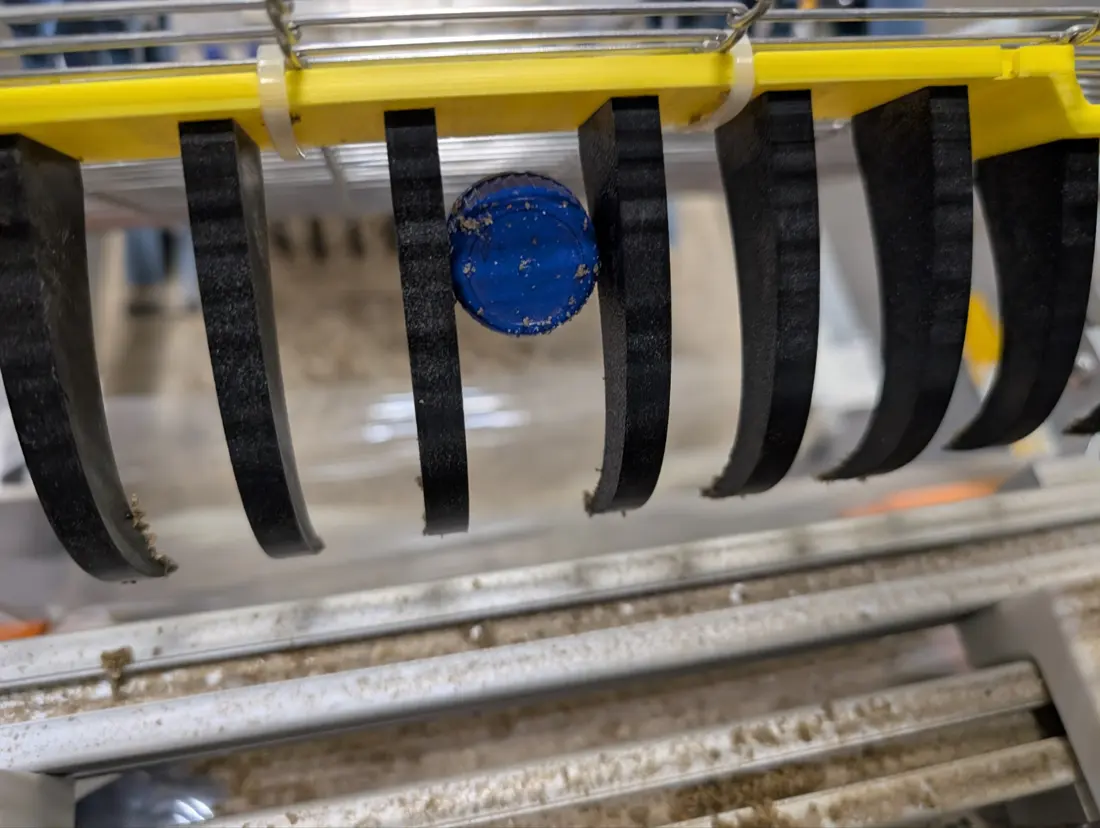
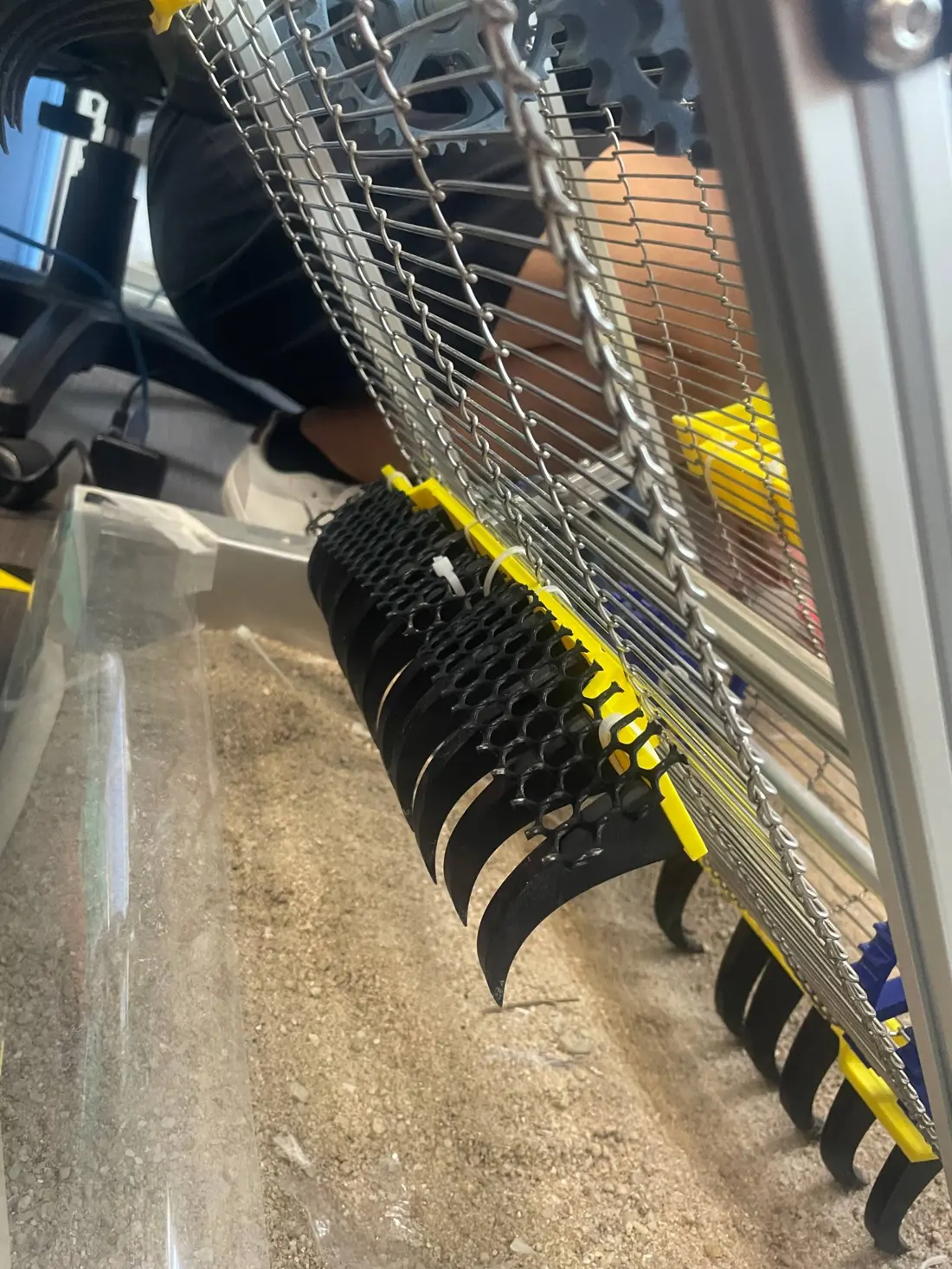
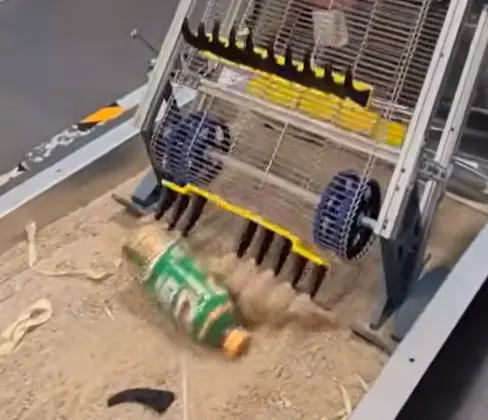
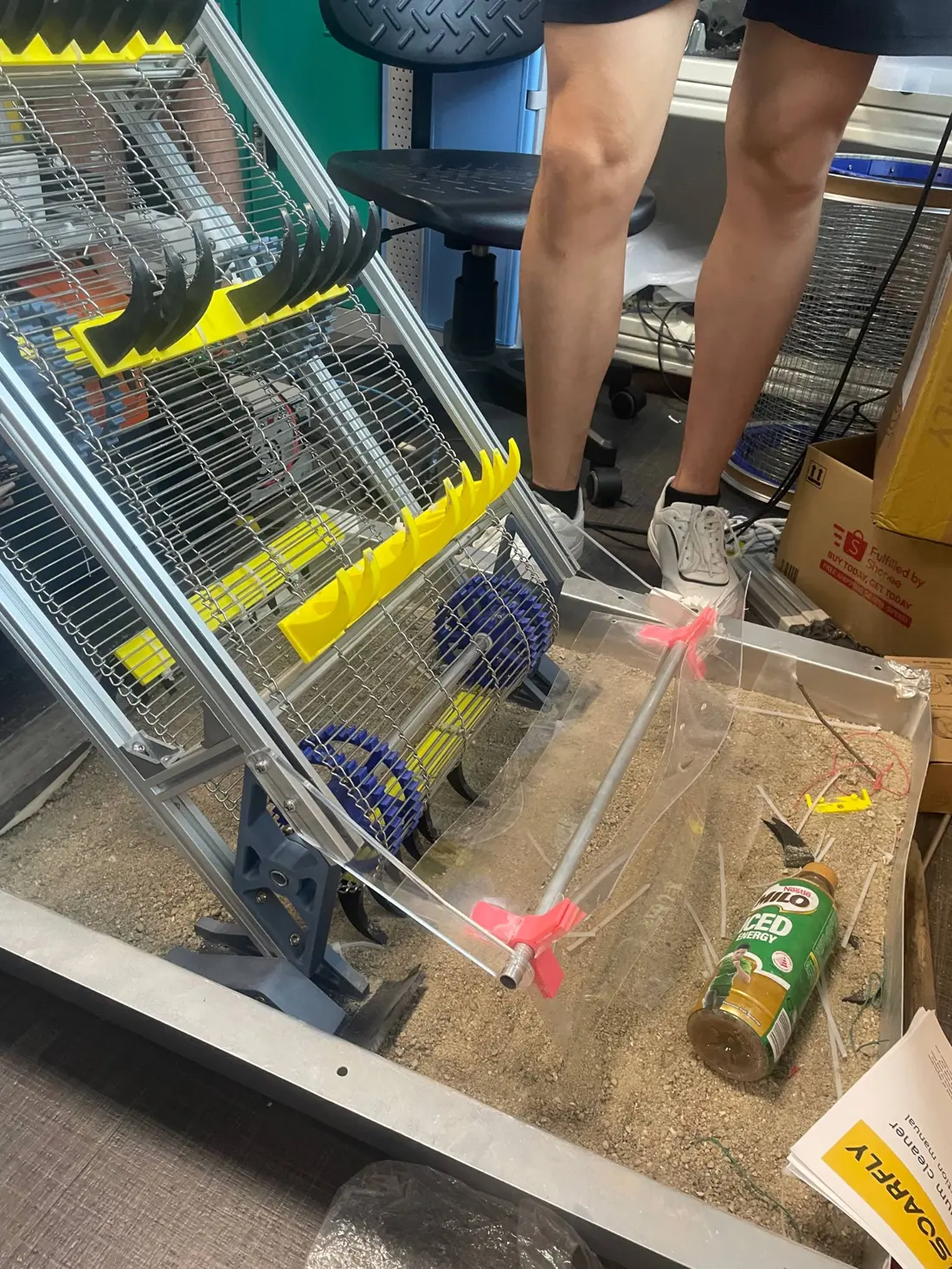
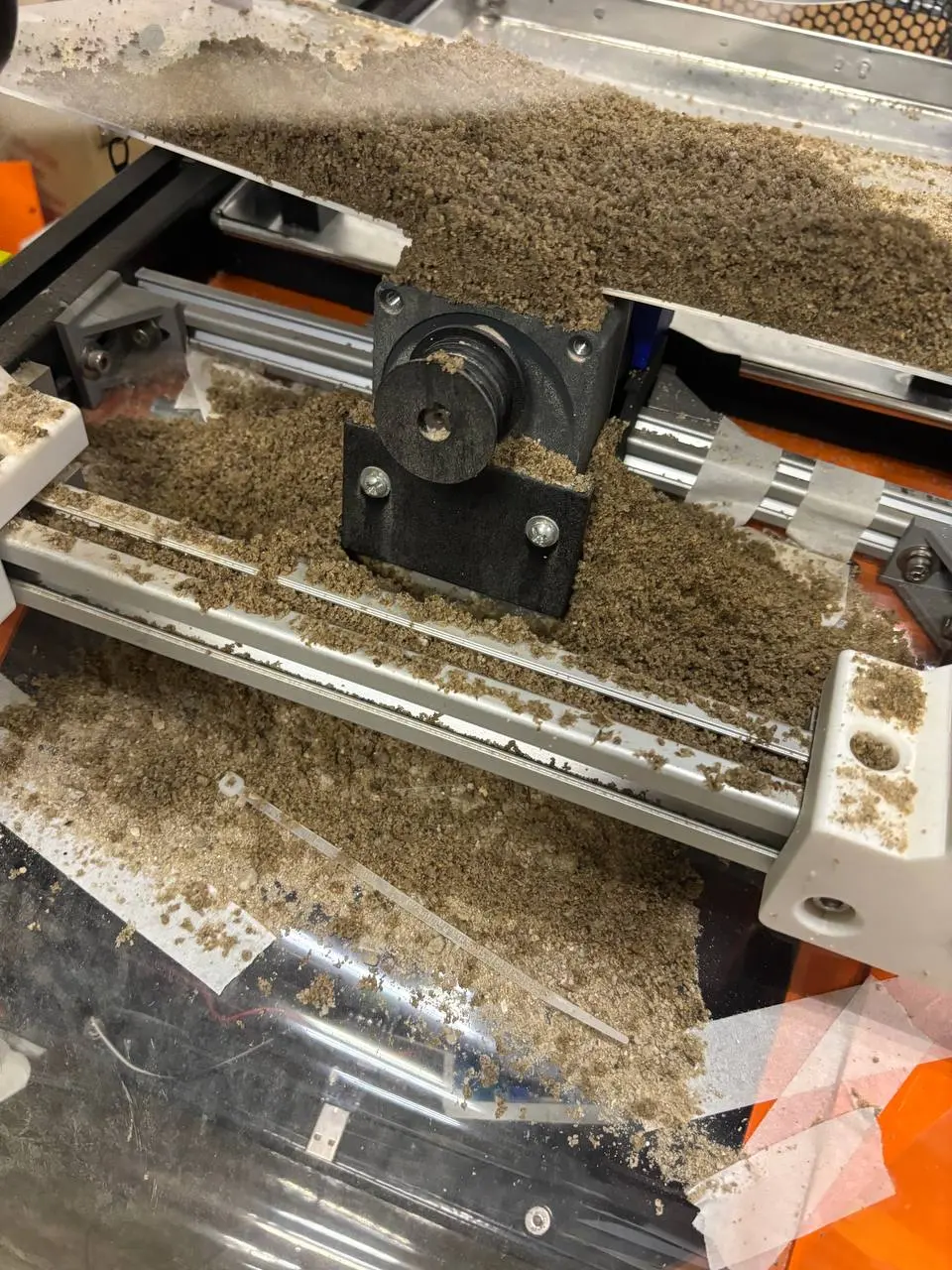
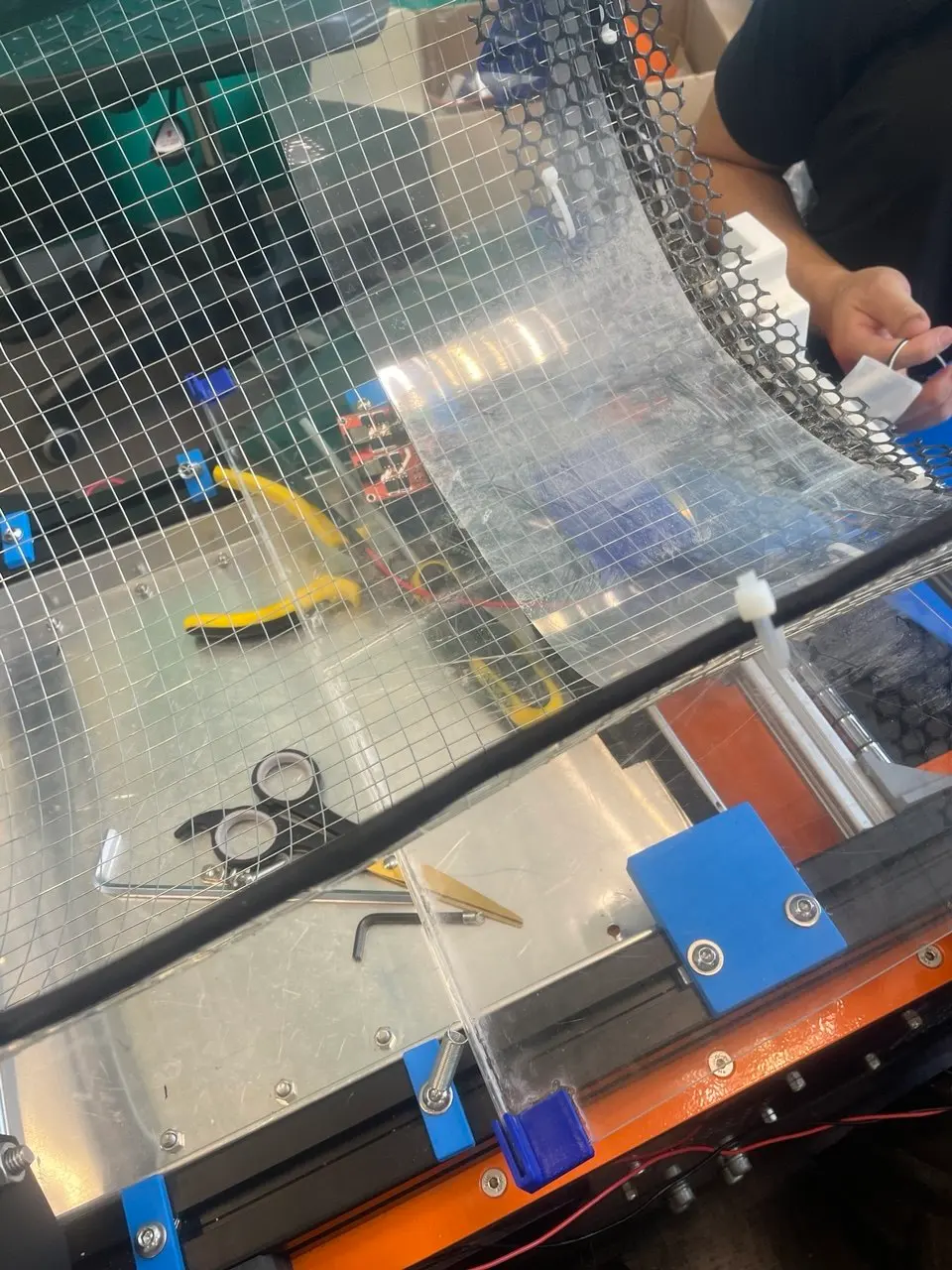
Capstan string will not hold tension. Belt drive trialled and rejected, friction drive on springs fitted. After the second session, paddle flaps were replaced with rubber sheets because the sweeper jammed debris at the intake, and the polycarbonate sheet and V plate were reduced because sand clumped on them.
Design report, Tables 6 and 9, Appendix H.5Separate checks
| Check | Result | Threshold | Met |
|---|---|---|---|
| Mobility, road | Route completed with the 10 kg payload. Humps crossed with the conveyor fitted. Video | Moves with a 10 kg payload | Yes |
| Mobility, sandpit | Forward, reverse and turning motion all traverse the sand. Video | Moves with a 10 kg payload | Yes with some impeding of motion when turning |
| Noise | Stayed below 60 dB(A) at 1 m while traversing, with the conveyor and U plate running | Below 60 dB(A) at 1 m | Yes |
| Emergency stop | Robot drive, conveyor and U plate all stopped immediately | Mechanism stops immediately | Yes |
Field testing · Palawan Beach, Sentosa
The sandpit had no slope.
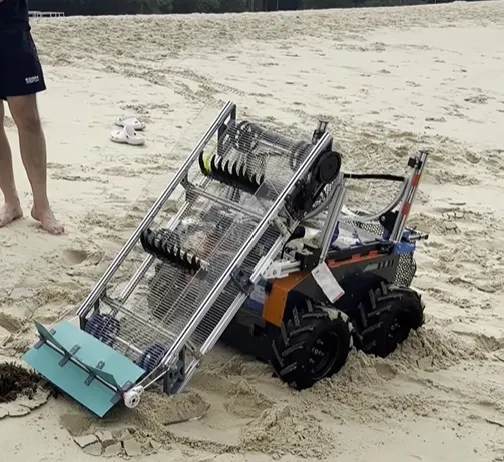
The wet band lies on a cross-slope, steeper than anticipated, so debris on the conveyor slid back off sideways before reaching the half-drum. The acrylic panels meant to counteract this were not present at the transfer.
The level sandpit could not reproduce it.
Field results
Collection fell well short of the target.
The same controlled dataset, on dry and wet sand in field conditions, with and without the sweeper. Collection rate is the proportion of placed debris taken off the sand and carried clear of the conveyor in one pass.
Design report, Glossary, Section 4.2, Figure 18. Watch the field testWhere the debris was lost
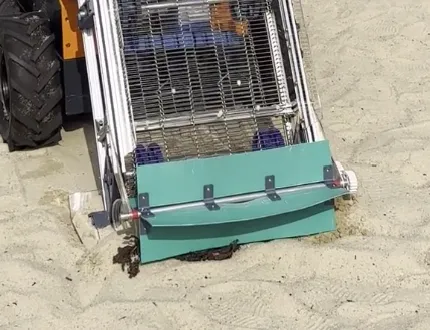
Intake is below the 80% threshold in all four conditions, but moisture makes its difference at transfer. Dry holds at 100%, while wet reaches at most 16.7% overall, against 89.5% in the wet bench test at B4.0.
What went wrong, and what held
User tests and clear-out
Two workers attempted six operating tasks after a demonstration, then were interviewed with the on-site manager. One needed help to clear a jam and resume, the other to drive it to the working zone. All three found the machine less physically demanding than the current workflow. One operator and the on-site manager pointed to less bending to re-collect debris dropped by the bobcat. The other operator pointed to driving the machine instead of spending hours in the sun picking up debris.
Design report, Section 4.2, Tables 11 and I.3Problem-solution fit
Workflow answered. Collection not yet.
BeachBoy answers the workflow problem but does not yet collect enough debris to replace hand clearing of the wet band.
Design report, Tables 2, 7, 10, 11, 12 and I.3, Sections 3.2 and 4.2Future work
- Reduce transfer loss at the wet band, where the cross-slope tips collected debris back off the conveyor.
- Redesign the intake mechanism to improve the field collection rate and reduce intake jams.
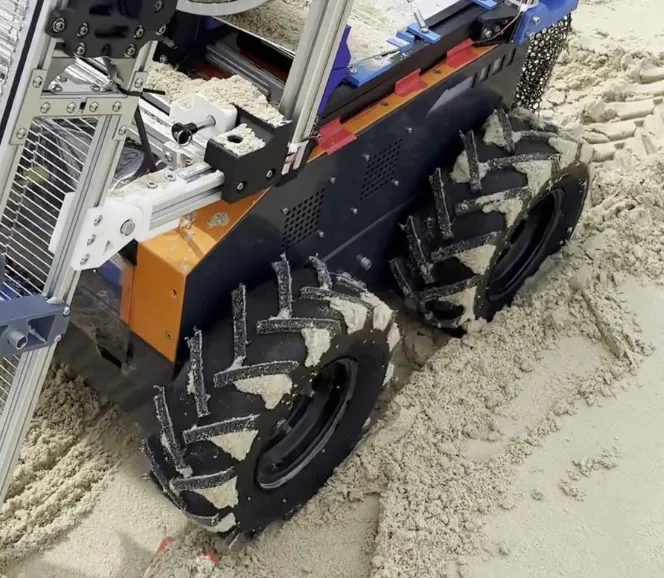
- Reduce locomotion impediment from the pivoting conveyor jamming, and from wheels digging in and slipping in wet sand.
- Design for material resilience with salt and wet sand resistance.
- Improve separation so that the majority of sand settles on the collection tray.
These tests should be done on the beach, because the sandpit was unable to provide the slope needed.
Design report, Section 4.4 and ConclusionCDE3301 Design Report · AY 2026/27
Submitted by
- Chen Zhi Yi GaryCAD modelling and mechanical design of the trommel screen system
- Jeon WonjeBrought and kept the team together
- Kow Ming YuanTrommel drum subsystem, testing metrics and build log
- Ng Jing Jie RussellWorked through the conveyor-to-drum handoff
- Wang YizhangDesigned the modular conveyor
Supervised by Mr. Nicholas Chew and Mr. Royston Shieh.
Everything on this page comes from the ASI-301 design report. The full test methods and session records are in the build and test log.
3D carrier geometry from botsync/copernicus (BSD-3-Clause). Built with three.js.